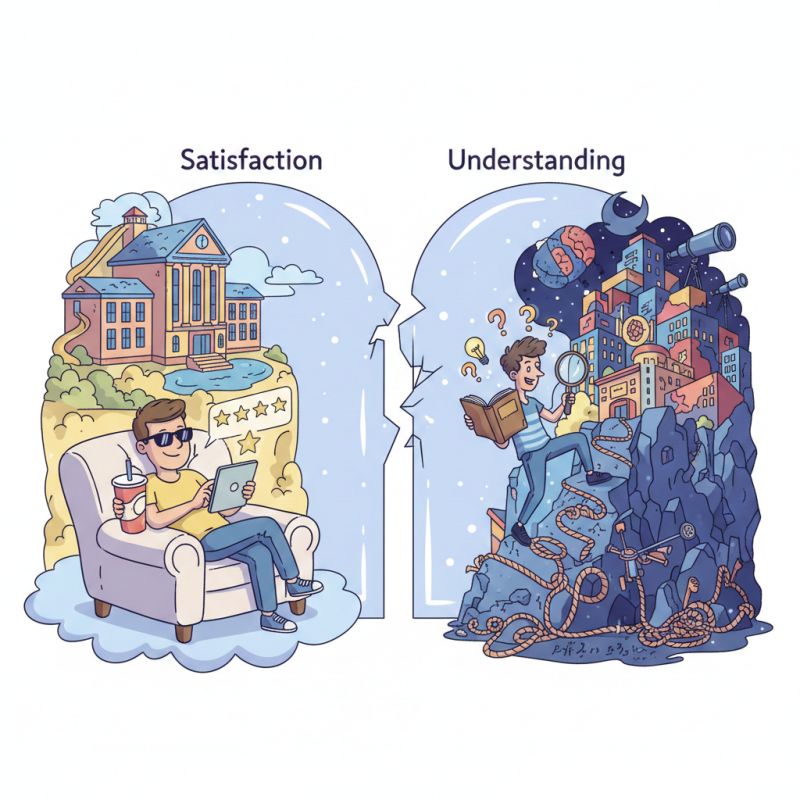
As universities increasingly adopt customer-centric models, a fundamental question emerges: are we designing education to maximize satisfaction, or to cultivate genuine understanding?
Global education is shifting from an intellectual endeavour to a hospitality-oriented service. Convenience, comfort, and “student experience” are often prioritized over deep engagement and meaningful learning. Educational quality is now informally judged through consumer-style satisfaction metrics, much like star ratings, despite the well-established reality that genuine learning is rarely comfortable.
Learning is supposed to be hard
Learning is an inherently demanding and often uneasy process. It requires sustained attention, effort, and intellectual struggle, very different from the ease of scrolling through social media or shopping online. Yet as education adopts a consumer-friendly mindset, the focus gradually shifts from cognitive development to experience management.
As a result, classroom teaching risks becoming a passive consumer experience rather than an active learning process in which participation and intellectual risk-taking are central. For many students, the classroom is also becoming a space of image management. The fear of being judged, of making mistakes, or of appearing uninformed restricts open discussion and curiosity. The central question slowly shifts from what students have learned to how students feel.
What the evidence says
Cognitive science supports this. The psychologist Robert Bjork described desirable difficulties: conditions that make learning feel slower and harder in the moment, such as retrieving from memory, spacing out practice, or wrestling with a problem before being shown the method, consistently produce deeper and longer-lasting learning. Ease feels like progress. Effort usually is progress.
The way we measure teaching compounds the problem. A large meta-analysis by Uttl, White, and Gonzalez found that student evaluations of teaching bear little or no relation to how much students actually learn. When such ratings shape faculty careers, teachers are quietly encouraged to make courses comfortable rather than demanding.
What we should measure instead
In this transition, education may appear more pleasant, but its intellectual horizons quietly narrow. The critical challenge before us is not to make education easier, but to ensure it remains meaningful.
The true measure of education lies in how far a learner’s thinking has expanded: how critically they can think, how confidently they can ask their own questions, and how independently they can seek answers, rather than how comfortable the journey felt.
None of this argues for indifference to students’ well-being. A good classroom is one where students feel safe enough to struggle, to be wrong, and to ask the naïve question. Safety and comfort are not the same. The first makes deep learning possible; the second, pursued for its own sake, quietly prevents it.
This shift deserves careful reflection from educators, institutions, and policymakers alike.
References & Notes
- R. A. Bjork, “Memory and metamemory considerations in the training of human beings,” in J. Metcalfe & A. Shimamura (eds.), Metacognition: Knowing about Knowing, MIT Press, 1994.
- B. Uttl, C. A. White, D. W. Gonzalez, “Meta-analysis of faculty’s teaching effectiveness: Student evaluation of teaching ratings and student learning are not related,” Studies in Educational Evaluation 54, 22–42 (2017).